DoubletCalc1D
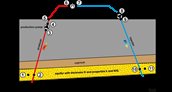
DoubletCalc1D is a software tool developed by TNO Geological Survey of the Netherlands (TNO-GDN) which calculates how much water can be pumped at a given pump power, given a doublet system and subsurface conditions. It is based on a simple subsurface model and standardised well design (Figure 1).
The DoubletCalc1D calculation method is the basis of the ThermoGIS calculation model. The software and manual can be downloaded from NLOG.
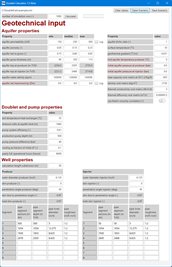
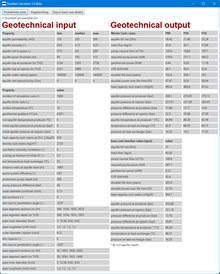
In the input screen (Figure 2), aquifer properties (depth, thickness, permeability, net-to-gross ratio and temperature), pump and doublet properties (return temperature, pump efficiency, pump pressure), and simplified well design are entered. It then calculates the flow rate this imaginary doublet can pump, what, given the return temperature, is the geothermal power, and, given the pump efficiency, the COP (coefficient of performance) (Figure 3).
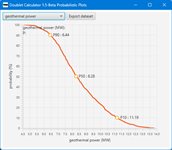
For the aquifer properties, DoubletCalc1D requires not only the expected value (median), but also estimates of the minimum and maximum values (min - max). For all properties, a triangular distribution is constructed using the min-med-max values. A large number of Monte Carlo calculations (typically >1000) are then performed , each time drawing a value from the distributions. This yields an expectation curve of the power (Figure 4). In this example, the expected power output is 8.34 MWth. The probability is 90% that the power output is at least 6.43 MWth, and 10% that it is more than 11.22 MWth. The most determining subsurface parameter for the uncertainty of flow and power is permeability.