How CO2SITE Connects European CO₂ Storage Knowledge
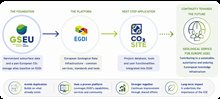
CO2SITE is part of a wider European system for geological data, knowledge and services. The Geological Service for Europe project, GSEU, the European Geological Data Infrastructure, EGDI, CO2SITE and the future Geological Service for Europe each have a distinct role. Their connections are important because they support the continued use, improvement and accessibility of information about geological CO₂ storage.
From geological expertise to long-term data services
GSEU: the knowledge foundation: GSEU brings together European geological expertise and harmonises knowledge across several themes, including sustainable geoenergy and CO₂ storage.
EGDI: the digital infrastructure: EGDI is the shared digital environment through which European and national geological datasets, metadata, maps and services can be discovered and accessed.
CO2SITE: investment-oriented CO₂ storage intelligence: CO2SITE builds on this foundation by expanding the European CO₂ storage knowledge base and developing tools for screening, assessment and comparison.
GSE: a long-term ambition: The future Geological Service for Europe represents a possible long-term setting in which useful geological data, methods and services can be maintained and further developed after individual projects end.
Together, these components form a connected ecosystem in which standards, methods, data, expertise and services can be reused and improved beyond the lifetime of a single project website.
Key concepts
FAIR data
FAIR means Findable, Accessible, Interoperable and Reusable. The FAIR principles help users locate information, understand its origin, combine it with other information and reuse it under clearly described conditions.
FAIR data are important for CO2SITE because the Atlas brings together information from many different countries and organisations.
Metadata
Metadata are information describing a dataset or service. They may explain:
what the data contain;
who produced or maintains them;
when they were last updated;
which geographic area they cover;
how they were produced;
their quality and limitations;
the conditions under which they may be used.
Good metadata allow users to understand the scope and limitations of information before comparing potential storage sites.
Storage Readiness Levels
Storage Readiness Levels describe how mature or well understood a potential CO₂ storage opportunity is.
A lower readiness level generally indicates that information remains limited or that a storage opportunity is at an early stage of investigation. A higher readiness level indicates that more evidence is available and that the opportunity may be closer to detailed appraisal or development consideration.
Storage Readiness Levels help users distinguish between broadly identified storage potential and opportunities supported by more detailed evidence.
Investability
Investability describes the combined factors influencing whether a potential storage opportunity is attractive and realistic for further development.
These factors may include:
geology;
capacity and injectivity;
containment and monitorability;
infrastructure;
regulation;
costs and risks;
data quality;
evidence maturity;
stakeholder and regional context.
A large theoretical capacity alone does not mean that a storage opportunity is ready or suitable for development.
Why continuity matters
The principal route to released CO2SITE Atlas functionality will be through EGDI. CO2SITE is therefore working within an established European data-service environment rather than developing an isolated digital tool.
This approach can make released data, methods and functionality easier to find, connect and reuse. It also creates a clearer route for their possible maintenance and further development after the CO2SITE project period.